The individual hearing: what happens at your asylum trial in immigration court
The individual hearing is where the judge decides your asylum case. It is also where the record is made that every later appeal will rely on.

Law checked October 6, 2026 · Updated
Updated October 6, 2026. We re-checked this post against primary sources and updated it. See what changed.
The short version
- The individual hearing is the merits hearing. You testify under oath, an interpreter is provided if necessary, and the judge may ask questions at any time.
- For people who are not detained, filings are generally due at least 30 days before the hearing, with responses within 10 days.
- You carry the burden of proving you qualify for asylum and that it should be granted as a matter of discretion.
- If the judge denies your case, an appeal to the Board of Immigration Appeals must be received within 30 calendar days.
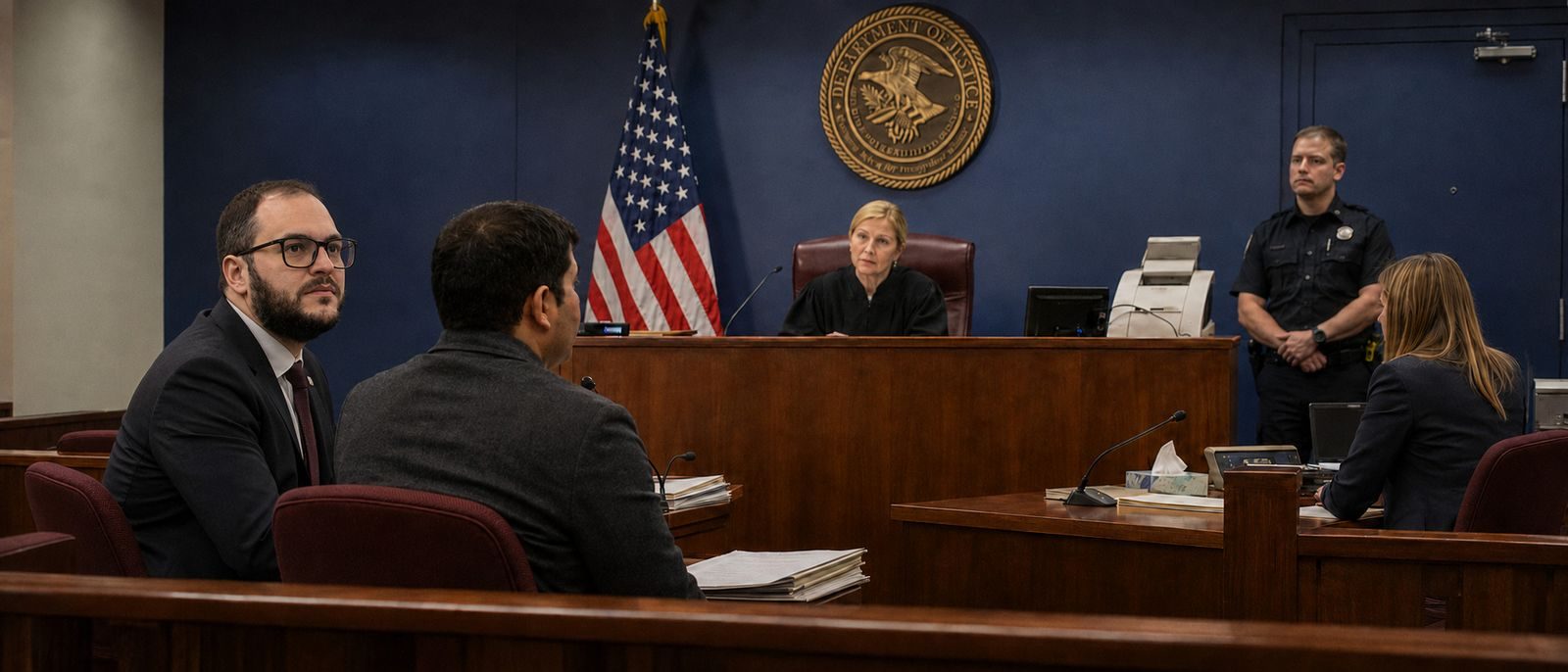
The individual hearing is the trial of your asylum case. It is sometimes called the merits hearing. You tell your story under oath, your evidence is considered, and the judge decides whether you qualify for asylum or another form of protection.
It is also the only chance to build the record. Later appeals look back at what was said and filed here. This post explains what happens, what the law asks you to prove, and what comes after.
What happens at the hearing
EOIR describes the individual hearing in its Immigration Court Practice Manual, Chapter 3.15. Three rules from that chapter are worth knowing before you walk in:
- The oath. All witnesses, including you, are placed under oath by the judge.
- The interpreter. An interpreter is provided if necessary. Tell your lawyer early which language you speak best, and say so on the day if you do not understand the interpreter.
- The judge's questions. The Manual says "The Immigration Judge may ask questions ... at any time." Do not be thrown if the judge interrupts.
Your lawyer will usually question you first. The lawyer for the Department of Homeland Security, the other side in the case, may question you as well. Answer the question asked. If you do not know or remember, say so.
Filing deadlines before the hearing
For people who are not detained, the Practice Manual's default rule is that filings for an individual hearing are due at least 30 days before the hearing. Responses to the other side's filings are due within 10 days. There is an exception for exhibits and witnesses offered only to rebut or impeach (Chapter 2.1(b)). In detained cases, the judge sets the deadlines.
If your asylum application was referred to the court by a USCIS asylum office, it is already in the court record and does not need to be filed again. Any amendment meets the ordinary deadlines and carries a cover page such as "AMENDMENT TO PREVIOUSLY FILED ASYLUM APPLICATION" (Chapter 2.1(b)(3)). If you are in that situation, our post on referrals without an interview may help.
A document counts as filed only when the court receives it. Our post on how immigration court deadlines are counted shows how to work out the exact date.
What you have to prove
The burden is on you. Under 8 C.F.R. 1240.8(d), you must show that you are eligible for asylum and that it should be granted in the exercise of discretion. If the evidence suggests that a ground for mandatory denial may apply, such as one of the bars to asylum, you must show by a preponderance of the evidence that it does not.
Eligibility starts with the refugee definition in INA 101(a)(42)(A). You must show persecution, or a well-founded fear of it, on account of race, religion, nationality, membership in a particular social group, or political opinion. That protected ground must be "at least one central reason" for the harm (INA 208(b)(1)(B)(i)).
Even if you are eligible, asylum is discretionary. The statute says the government "may grant" it (INA 208(b)(1)(A)). Withholding of removal and CAT protection use different standards; see our post on asylum, withholding and CAT.
Credibility and corroboration
Your testimony is the center of the case, and the judge decides whether to believe it. The statute tells the judge to look at the totality of the circumstances: your demeanor, candor and responsiveness, how plausible your account is, and whether it is consistent with your written application, with itself, and with other evidence such as State Department reports (INA 208(b)(1)(B)(iii)).
An inconsistency can count against you "without regard to whether an inconsistency, inaccuracy, or falsehood goes to the heart of the applicant's claim." The judge does not start with a presumption that you are credible. Our post on why small inconsistencies matter covers this in detail.
Testimony alone can be enough, but only if it is credible, persuasive and specific. If the judge decides you should provide corroborating evidence, the statute says "such evidence must be provided unless the applicant does not have the evidence and cannot reasonably obtain the evidence" (INA 208(b)(1)(B)(ii)).
The decision and the 30-day appeal clock
At the end, the judge decides. The decision may be given orally in court or issued later in writing.
If the judge denies your case, you can appeal to the Board of Immigration Appeals. The deadline is 30 calendar days, and the Notice of Appeal must be received by the Board within that time, not just mailed (8 C.F.R. 1003.38(b)-(c)). The clock runs from an oral decision, or from the mailing or electronic notice of a written one. Since October 1, 2026, the Form EOIR-26 appeal fee is $1,060, or you must file a Form EOIR-26A fee waiver request with it. Our post on the 30-day BIA appeal deadline explains why some old sources still say 10 days.
A denial also affects work permits. Under 91 FR 22952, employment authorization terminates 30 days after an immigration judge denies the application, or immediately if the Board denies the appeal.
Why the record you build now matters later
If the Board also denies the case, the next step is a petition for review in a federal court of appeals, due 30 days from the final order of removal (INA 242(b)(1)). That court does not rehear your story. It reviews the record.
In Urias-Orellana v. Bondi (2026), the Supreme Court held unanimously that courts of appeals review whether facts amount to persecution under the deferential substantial-evidence standard. The judge's findings stand unless the record compels the opposite conclusion. Our post on Urias-Orellana v. Bondi explains why that makes the individual hearing the place where cases are won or lost.
No two asylum cases are alike, and how to prepare depends on your facts, your evidence and your judge. If you have an individual hearing scheduled, talk to an immigration lawyer about your own case well before the 30-day filing deadline.
Questions people ask
Do I need to bring my own interpreter to immigration court?
EOIR's Practice Manual says an interpreter is provided if necessary at the individual hearing. Tell the court your best language early, and tell your lawyer if you have trouble understanding the interpreter on the day.
When are my documents due for the individual hearing?
If you are not detained, filings are generally due at least 30 days before the individual hearing, and responses to the other side's filings within 10 days. A judge can set a different schedule, and detained cases follow the judge's schedule.
What happens if the judge denies my asylum case?
You can appeal to the Board of Immigration Appeals. The Notice of Appeal must be received by the Board within 30 calendar days of the decision, with the fee or a fee waiver request.
Sources
Every rule in this post was checked against these primary sources on October 6, 2026. Law in this area changes often; if you are reading this much later, ask a lawyer what has moved.
- INA 208(b)(1); 8 U.S.C. 1158 (discretion, nexus, corroboration, credibility)
- INA 101(a)(42)(A); 8 U.S.C. 1101 (refugee definition)
- 8 C.F.R. 1240.8(d), burden of proof
- 8 C.F.R. 1003.38 (appeal deadline, receipt rule, fee)
- EOIR Policy Manual, Immigration Court Practice Manual Ch. 2.1(b) and 3.15
- EOIR Policy Manual, Part III, BIA Practice Manual Ch. 3.5
- 91 FR 22952 (4/29/2026) (employment authorization after a denial)
- INA 242(b)(1), (b)(4)(B); 8 U.S.C. 1252
- Urias-Orellana v. Bondi, No. 24-777, 607 U.S. ___ (Mar. 4, 2026)
- EOIR FY2027 fee adjustment, 91 FR 54211 (Aug. 21, 2026)
More on this from other sources
- Trump administration held talks with Iran on deporting Iranians during the war, court documents show (opens PBS NewsHour in a new tab)
- No Notice, Know Problem: Immigration Court Edition (opens The Asylumist in a new tab)
- Türkiye: European Court to Rule on Istanbul Mayor’s Detention (opens Human Rights Watch in a new tab)
- In 100th lawsuit against Trump, California challenges immigration arrests near courthouses (opens Los Angeles Times in a new tab)
- ICE Says It Can Detain Immigrants as Long as It Wants. Will the Supreme Court Agree? (opens The Marshall Project in a new tab)
- More Sneaky Ways to Deny Asylum, Courtesy of the Asylum Office (opens The Asylumist in a new tab)
Headlines from other publishers, updated November 5, 2026. We link to them; we do not write or endorse them. All news and blogs
Videos worth watching
- Individual Model Hearing (John Doe, Case Number 123-456-789) (opens YouTube in a new tab)
- Ordered Deported and Didn't Know It? The In Absentia Removal (opens YouTube in a new tab)
- Master Calendar Model Hearing (John Doe, Case Number 123-456-789) (opens YouTube in a new tab)
Videos by other creators, picked for clarity. Older videos can show old fees or rules; the dates and amounts in our posts are current as of the date shown at the top.
Written by
Alexander Susi, Esq.
Executive Senior Associate · Admitted in NY, NJ, PA
Alexander Susi handles immigration matters from deportation defense through asylum, along with civil and commercial litigation. He is admitted in New York, New Jersey and Pennsylvania, in the Second Circuit, and before the immigration courts and the Board of Immigration Appeals. He studied at New York University and Boston University School of Law.